
Curve, wave
how to see wind

Palouse loess is a fine composite silt ground down by glacial action (both explosive and otherwise) and then blown back again to form our dunes/hills. This grinding and blowing happened in rounds up until about 12,000 years ago, forming the rolling landscape. The valley I live in behaves like a wind tunnel, with gusts roaring through from the Wallula Gap loud enough to be convincing as a sculptural force. And yet, except in snow drifts or the rare dust storm, it can be hard to see, in real-time, how wind is still shaping things here.
Tried to grow corn in our wind-tunnel garden several years ago, producing zero mature ears but some very beautiful leaves. Ribbed and subtly colored in gold, dun, purple and green they curve in spirals and waves - quietly eloquent of both wind and cellular mechanics. Held in a certain way they even resemble dunes – a kind of re-scaling/recurrence of form that I totally love.
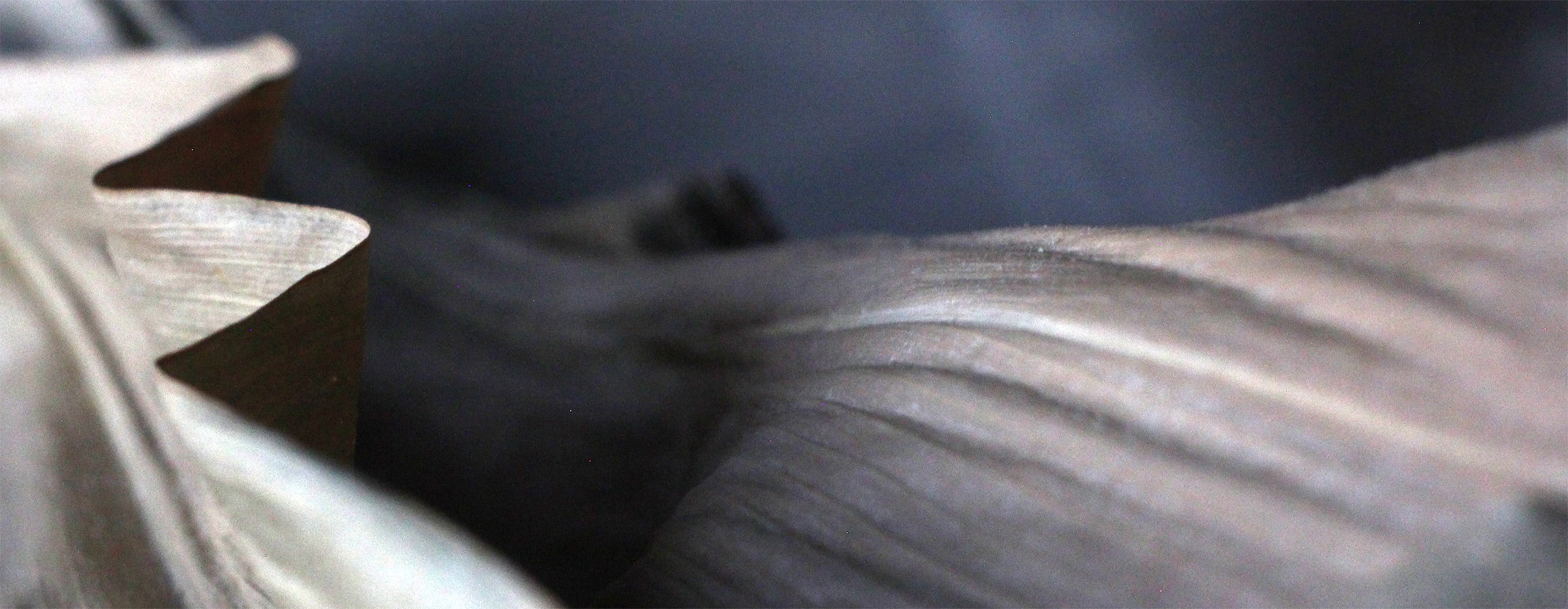
For the Loess installation I hung preserved leaves in a “raft” – a moving, undulating net of dangling leaves that turn and tassel with gentle airflow (tiny mounted fans). The hang points also shape the net so that the weight of the leaves, little as it is, creates curving forms as well. The raft is in the gallery front window so that the movement catches the eye in passing - heard a tiny girl yell to her family, “Oh! It’s fish!”


Leaves used for this batch came from my (again non-corn-producing) corn field and those of obliging local farmers and research labs. My sister and friends pitched in for some very long hours of leaf processing and bathing and a work party from the Palouse Women Artists crew helped add the tiny hooks.
Remembered:
Gaudi’s beautiful hanging models in the basement of the Basilica de la Sagrada Família, Barcelona.

deep and beautiful imagery.... I feel the invisible wind!